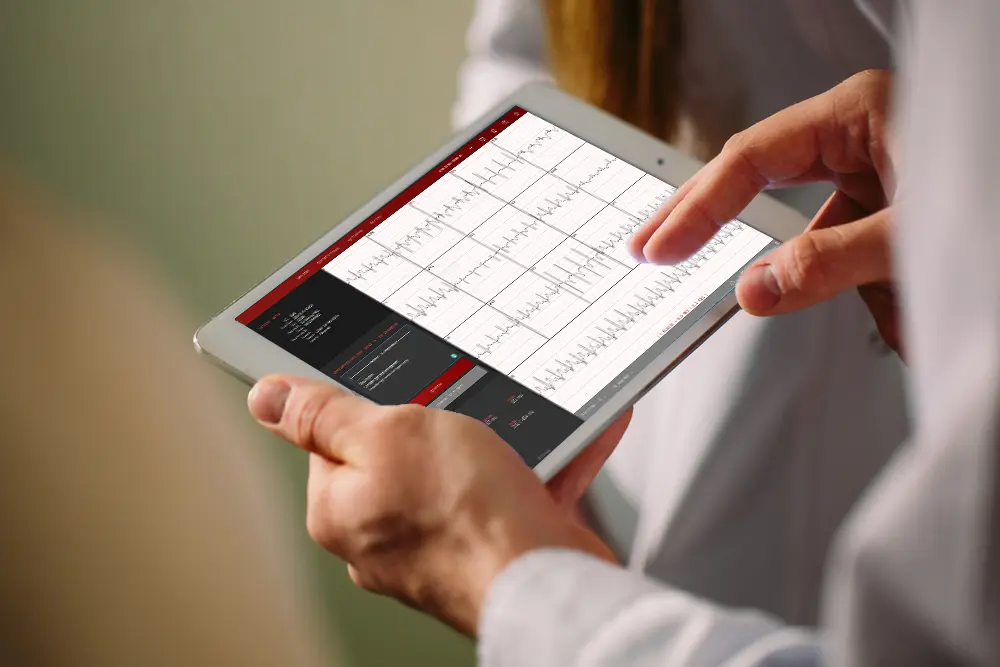
Every year, cardiology departments perform tens of thousands of electrocardiograms: resting 12-lead, stress ECGs, Holter monitors, and wearable device recordings that stream data through the night. ECGs are among the most frequently ordered diagnostic tests in medicine, foundational to everything from a routine annual visit to a STEMI workup in the emergency department.
And yet, for all the technological sophistication that defines cardiovascular medicine today, ECG data remains one of the most poorly managed pieces of the cardiac puzzle. Across hospitals, independent cardiology practices, outpatient clinics, and busy emergency departments (ED) alike, ECG tracings still routinely live in a standalone acquisition system or a legacy database with no meaningful connection to the cardiovascular imaging platform, the EHR, or the broader CVIS.
Cardiologists read from one screen, pull history from another, and dictate into a third. The tracings are there, somewhere, but rarely where they need to be, when they need to be there.
This isn’t a technology gap. The tools to solve it exist. It’s an integration gap, and its effects ripple across the entire care continuum in ways worth examining honestly.
Fragmented Data, Incomplete Clinical Picture
Ask any cardiologist what they need at the point of interpretation, and the answer is consistent: context. An ECG read in isolation tells part of the story. An ECG read alongside a prior echo, a stress test result, a recent cath report, and six months of Holter data tells a very different one.
The problem is that in most cardiology environments, hospital-based or otherwise, those data sources live in separate systems, often from different vendors, often requiring separate logins, with no native ability to display data side by side. Many teams are still using platforms originally designed for radiology workflows. Even in multi-site or cloud-based environments, cardiac data remains surprisingly siloed.
The clinical consequences are real. When a cardiologist interpreting a new 12-lead can’t readily see that the patient had a similar pattern six months ago, or that a recent echo showed borderline LV function, diagnostic confidence takes a hit.
Critical comparisons get skipped, not because clinicians don’t want to make them, but because finding the prior data takes more time than most workflows can accommodate. For a solo practitioner or a high-volume ED physician clearing a queue, “I’d have to log into a different system” functionally means “it didn’t happen.”
Duplicated Entry and the Hidden Cost of Manual Workflows
When ECG systems don’t connect to the broader cardiovascular imaging environment, data doesn’t flow; it gets re-entered. Patient demographics get typed in twice. Ordering information gets re-keyed. Interpretation notes get documented in one system, then summarized again for the EHR. Every manual handoff is a point of friction, and every point of friction carries risk.
This is more than a productivity complaint. Duplicate data entry is a patient safety issue. Studies on clinical documentation consistently show that errors increase in proportion to the number of manual handoffs in a workflow. In cardiology specifically, where a missed interval measurement or a transposed patient identifier can carry downstream consequences, the stakes are higher than in most specialties.
There’s also the operational math. Health IT administrators managing multi-site cardiology programs, ambulatory networks, or independent physician groups understand this well: bolt-on vendors, multiple logins, disconnected data silos, separate contracts, separate support teams, and separate upgrade cycles don’t scale. The administrative overhead compounds every quarter.
Lost Clinical Time Across the Continuum
Physician time is the scarcest resource in most health systems, and the problem isn’t confined to large academic medical centers. Independent cardiologists, outpatient imaging centers, and clinicians covering satellite locations all feel the drag of fragmented ECG workflows: logging into secondary systems, hunting for priors, and manually pulling tracings before a read.
Consider a reading service that reviews 50 ECGs per day. If each study requires navigating between two systems and manually retrieving prior comparisons, even two or three minutes of friction per study adds up to hours of lost capacity each week. Multiply that across a department and across a year, and the number becomes significant.
The impact extends beyond physician productivity to turnaround time, patient throughput, and the downstream responsiveness of the cardiology service to referring physicians, inpatient care teams, and patients waiting on results. For organizations pursuing accreditation, documentation gaps from fragmented systems create an entirely avoidable category of risk.
The Revenue Leak No One Is Tracking
Multiple cardiology revenue cycle analyses indicate that a meaningful share of cardiac diagnostic tests, including ECGs, never make it into a claim at all due to workflow gaps. The loss is particularly insidious because unreconciled ECGs rarely generate patient complaints; the revenue simply disappears quietly.
The risk is elevated for ECGs specifically because they are performed at high volume, often across multiple settings (inpatient floors, outpatient clinics, emergency departments, satellite locations), and are frequently dependent on precise documentation and interpretation timing for proper charge capture. When those steps are distributed across fragmented systems, charges fall through the cracks, not through negligence, but through structural workflow failure.
What Integrated ECG Management Actually Solves
The shift from standalone ECG systems to fully integrated cardiology PACS and CVIS platforms addresses these problems at the source rather than patching around them. When ECG waveforms, diagnostic measurements, and physician interpretations are captured, stored, and accessed within the same system as echocardiography, vascular imaging, and stress testing data, the workflow changes fundamentally.
Clinicians across the care continuum get a complete, longitudinal cardiac record in a single interface, whether they’re a cardiologist in a reading room, a hospitalist on rounds, or an ED physician managing a chest pain workup. Prior studies surface automatically. Structured reports auto-populate from acquisition data. Interpretations feed directly into billing workflows without a manual handoff.
PICOM365 by ScImage is built around this model. Rather than bolting ECG management onto an existing imaging archive, PICOM365 unifies ECG data, including resting 12-leads, 15-lead tracings, Holter monitors, pacemaker data, wearables, and stress ECGs, within its enterprise cloud PACS environment alongside the full spectrum of cardiovascular imaging modalities.
Clinicians across the care continuum, from large health systems to independent cardiology practices and outpatient imaging centers, access the same data through the same interface, from anywhere.
The platform enforces a closed-loop workflow: order received, ECG acquired, interpretation completed, report finalized, billing triggered. No step can be skipped, and no study goes unaccounted. PicomAnalytics provides dashboards that surface completed versus billed ECGs, physician productivity metrics, and workflow bottlenecks, giving administrators the visibility to identify and close revenue gaps before they compound.
The result is a cardiovascular imaging ecosystem that supports clinicians at every point in the healthcare continuum: seamless EHR integration, enterprise accessibility for multi-site and telecardiology workflows, AI-ready infrastructure for post-processing and clinical decision support, and the scalability to grow from a single-physician practice to a multi-hospital enterprise without replacing the foundation underneath.
The Integration Gap Is Solvable
The frustrations cardiologists and health IT teams experience with ECG data management are not a permanent feature of the landscape. They are the residue of a generation of systems built before true enterprise integration was achievable, and they are increasingly out of step with what modern cardiovascular information systems can deliver.
For organizations still managing ECG data in a silo, the question isn’t whether integration is worth pursuing. The clinical, operational, and financial case is clear. The question is how quickly the gap between where workflows are and where they need to be can be closed.